Litmatch—Make new friends
- 3.9
- Rating
- 100.00M
- Installs
- Free
- Price

 Analysis by App-foxy
Litmatch—Make new friends is a social app I would describe as a low-pressure place to meet people through conversation rather than a polished dating service or a conventional messaging tool. After spending time with it, my main impression is that it works best when you want casual interaction, short exchanges, and the possibility of finding people outside your existing circle. It is less convincing if you expect every conversation to become a lasting friendship or if you prefer a tightly controlled, private social experience.
The app is free to install, belongs to the social category, and is developed by CONSTRUCT TECHNOLOGY. Its audience is clearly mature, with a Mature 17+ content rating, so I would not treat it as a general-purpose app for younger users. The large user base helps the central idea: meeting someone new does not feel like an unusual activity here. At the same time, a large community also means that the quality of interactions can vary widely from one person to the next.
How Litmatch feels in everyday use
I find Litmatch easiest to judge by the kind of social effort I want to make: a quick exchange with someone new is different from maintaining friendships or joining a shared-interest group. In this section, I’ll look at how that distinction plays out in ordinary moments, including when a brief chat feels worthwhile and when I’d rather use a more familiar social space.
You May Also Like

 AccuWeather: Weather Radar
AccuWeather Review: A Quick, Clear Forecast for Everyday Decisions
For everyday plans, the best forecast is the one you can understand quickly. AccuWeather makes rain timing, radar, and local conditions easy to act on, with a few trade-offs.

 Hill Climb Racing
Why Hill Climb Racing Still Turns Crashes Into One More Run
A tiny car, a bumpy hill and one more upgrade: Hill Climb Racing keeps resurfacing because its simple chaos makes every near-miss feel personal.

 AliExpress - Shopping App
AliExpress Makes Global Shopping Feel Personal, but Shoppers Bear the Risk
AliExpress turns a global marketplace into a pocket-sized discovery engine. Its reach is useful, its shopping loop compelling, and its trade-offs easy to miss.

 Lords Mobile: Kingdom Wars
Lords Mobile Is a Kingdom-Building Routine, Not a Quick Match
A case-by-case verdict on the building, battles, device demands, and social commitments that make Lords Mobile rewarding for some players and exhausting for others.

 PDF Scanner app - TapScanner
TapScanner Makes Paperwork Easier to Capture, Check, and Share
TapScanner makes scanning with a phone feel less like a rescue operation and more like a dependable step in getting work done. Its capture tools are useful, though not flawless.

 Block Blast!
 Shows How Much a Puzzle Game Can Leave Out
A quiet grid game shows why puzzle players increasingly value instant clarity, repeatable skill and low-pressure play—and where the genre still needs to catch up.
More From Our News Desk
View All News


A social space built around discovery
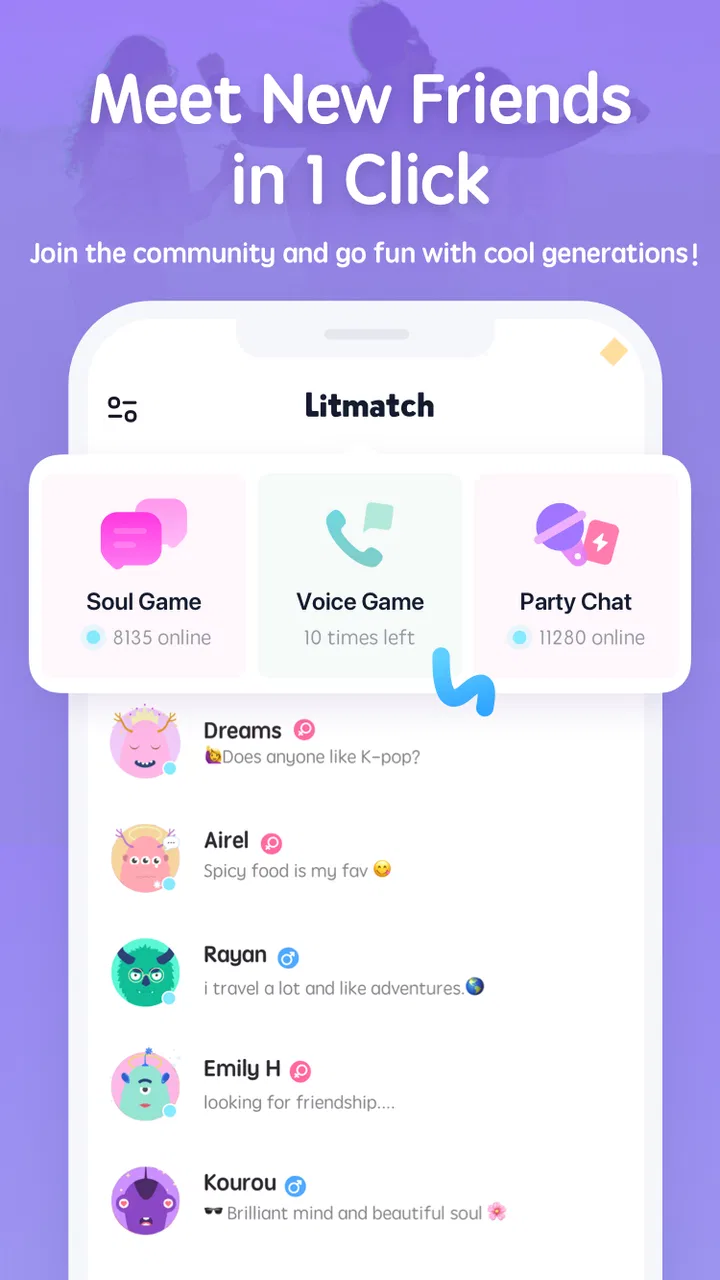
What separates Litmatch from a normal chat app is the starting point. In WhatsApp, Messenger, or iMessage, I usually know who I am contacting before I open a conversation. Here, the purpose is closer to browsing for social possibilities. I can enter with no established contact list and still have a reason to stay, because the app is designed around meeting unfamiliar people.
That makes it useful during moments when ordinary social apps feel repetitive. If I have a few spare minutes during a commute, a quiet evening, or a break from work, I can use it for lightweight conversation instead of scrolling through posts from people I already know. The experience is not necessarily deep every time, but it can feel more active than passively consuming a feed.
I also like that the app does not require me to frame every interaction as a serious friendship search. Some users may want regular conversation, while others may simply be looking for a friendly exchange. That flexibility is one of its strongest qualities. It gives the service a more relaxed mood than platforms where every profile seems to be competing for attention or presenting a carefully edited identity.
Where the app is genuinely useful
One realistic use case is someone who has recently moved to a new city and wants to practice talking with people before trying to build an offline social circle. Litmatch can provide an easy first step: brief conversations, shared interests, and a chance to learn what kinds of people are active in the community. It does not replace meeting people in person, but it can reduce the awkwardness of starting from zero.
It can also suit people who are shy in face-to-face settings. Writing a first message gives me more time to think than approaching a stranger in a café or joining a group conversation. That small difference matters. I can decide how much to reveal, stop replying when the exchange feels uncomfortable, and avoid committing to a long conversation just because it began politely.
Another practical use is language practice. I would not rely on the app as a structured language-learning course, but casual exchanges with people from different backgrounds can make practice feel less artificial. The trade-off is that conversation quality depends on finding a patient and respectful partner. Some interactions may be helpful, while others may end quickly or never move beyond simple introductions.
The strongest advantage is low commitment
My favorite part of Litmatch is the low commitment of its social model. I do not have to organize a group, maintain a public profile for a professional audience, or turn a conversation into a permanent connection immediately. I can explore, respond, and leave when my attention runs out.
That sounds simple, but it changes how the app feels. Traditional social networks often reward constant posting, visible popularity, and keeping up with an expanding list of contacts. Litmatch is more appealing when I want a direct social moment instead of another feed to manage. Its best use is casual discovery, not replacing every other form of communication.
The app’s popularity supports that purpose. It has passed one hundred million installs and holds an average rating of 3.9 from around one point three million ratings. Those figures suggest that the concept has reached a broad audience, although they should not be mistaken for a guarantee that every user will find compatible conversations. A large pool improves the chance of finding someone interesting, but it also creates more variation in behavior and expectations.
What I would do before starting conversations
I would begin with a simple profile rather than sharing personal details immediately. A short description of interests is enough to give another person something to respond to. I would avoid adding a workplace, school, neighborhood, daily routine, or other information that could identify me too easily. This is especially important because the app is designed to connect strangers, and friendliness should not be confused with trust.
I would also decide in advance what kind of interaction I want. If I am only looking for a few minutes of conversation, I would not imply that I am seeking a close friendship. Clear expectations make it easier to leave politely when the exchange is not a good fit. If someone pushes for private information, money, or communication outside the app too quickly, I would end the conversation rather than trying to explain myself at length.
A useful habit is to judge consistency instead of charm. A person who seems pleasant in the first few messages may still become demanding or disrespectful later. I would pay attention to whether they accept a delayed reply, respect a boundary, and show interest in an actual conversation rather than asking for personal access. That approach is more valuable than trying to optimize a profile for maximum attention.
The meaningful weakness: openness brings uneven experiences
The same openness that makes Litmatch interesting is also its main weakness. When an app encourages contact between strangers, I cannot assume that every interaction will be thoughtful, genuine, or worth continuing. Some conversations may be repetitive. Others may feel rushed, one-sided, or focused on moving the relationship somewhere I did not intend.
This is not a flaw unique to Litmatch, but it matters more here because meeting new people is the central activity. On a family messaging app, my contacts are usually people I already know. On a professional network, the social context is clearer. On a dating service, users generally understand that romantic interest may be involved. Litmatch occupies a less defined space, and that ambiguity can be both freeing and confusing.
I would not choose it if I wanted a carefully moderated environment with a narrow purpose. I also would not recommend it to anyone who finds frequent unsolicited attention stressful. The ability to meet people quickly is valuable only when the user feels comfortable filtering, ignoring, and ending conversations.
Costs, age suitability, and the free experience
Litmatch is free, but it includes in-app purchases ranging from very small amounts to as much as $254.99 per item. I would therefore treat the free version as the sensible starting point and avoid spending until I understand which parts of the experience I actually use. Social apps can make optional purchases feel tempting when I am trying to improve visibility or continue an interaction, so setting a personal limit before buying is a practical precaution.
The Mature 17+ rating is another important part of the decision. I would not install it for a child simply because the interface looks approachable or the goal sounds friendly. Parents choosing social apps for teenagers should consider the difference between a controlled contact list and an open environment where strangers may initiate conversations. For adults, the rating is a reminder to use ordinary online safety habits rather than assuming that a friendly tone means a low-risk setting.
The current version is 7.72.1 and it supports Android 7.0 or later. That makes it accessible on many older Android phones, which is useful if I am not using a recent device. Still, compatibility alone does not tell me how comfortable the app will feel on every phone. I would keep enough storage available for updates and pay attention to how the app fits into my normal notification habits, because a social service becomes irritating when it constantly pulls me away from other tasks.
How it compares with familiar alternatives
Compared with WhatsApp or Messenger, Litmatch is better for starting from no contacts and discovering unfamiliar people. Those established messaging apps are stronger when I already know who I want to reach and need dependable conversations with friends, relatives, or colleagues. I would not move an existing family group to Litmatch, but I might use Litmatch when my goal is meeting someone new.
Compared with Instagram or TikTok, it is more conversation-oriented and less dependent on watching a stream of public content. The usual short-video platforms are better when I want entertainment, creators, and a highly visual browsing experience. Litmatch makes more sense when I want interaction rather than an endless sequence of clips. The downside is that conversation requires more effort: I have to respond, ask questions, and decide whether a connection deserves more time.
Compared with dating apps, the purpose is less clearly romantic. That can be a benefit for someone who wants friendship or casual chat without presenting every interaction as a potential date. It can also be a drawback for someone seeking a focused relationship platform, where profiles, intentions, and matching tools are usually organized around dating. I would choose Litmatch only if its broader social atmosphere matches what I actually want.
Compared with Discord, Litmatch is more suitable for individual discovery than for joining established interest communities. Discord is often strongest when I already know the topic or group I want to follow. Litmatch is more spontaneous, but that spontaneity means the conversation itself has to provide the structure. If I want organized discussions about games, technology, music, or a hobby, a dedicated community platform may be a better fit.
Three practical ways to get more from it
First, I would use short conversations as a filter rather than treating every new contact as a commitment. A few thoughtful questions can reveal whether someone is curious, respectful, and compatible with my communication style. If the exchange remains vague or uncomfortable, leaving early saves time and prevents the pressure that can come from maintaining a connection out of politeness.
Second, I would separate friendliness from access. Being warm does not require sharing a phone number, social handle, location, photos, or private history. I would keep the early stage inside the app and move elsewhere only when trust has developed naturally. Even then, I would share gradually. This workflow is especially useful on a platform whose main appeal is meeting strangers.
Third, I would use the app in defined sessions instead of leaving it open whenever I am bored. A short evening check-in can help me enjoy the social side without turning it into another source of constant notifications. This also makes it easier to notice whether I am actually having worthwhile conversations or simply opening the app out of habit. For me, Litmatch is more enjoyable when it supports my day rather than filling every quiet moment.
Who should try it, and who should skip it
I think Litmatch is a good choice for adults who want casual conversations, enjoy meeting people beyond their existing circles, and are comfortable managing boundaries. It may be particularly useful for someone who has moved, works remotely, wants low-pressure social practice, or simply misses the surprise of talking with a new person. The free entry point makes it easy to test without treating the app as a major commitment.
I would recommend skipping it if you want a private messenger for people you already know, a structured course for language learning, a focused dating service, or a topic-based community with clear moderation and shared interests. It is also a poor fit if unexpected contact makes you anxious or if you tend to spend impulsively on social features. A different app will serve those needs more directly.
My final view is positive but measured. Litmatch succeeds because it makes starting a conversation feel easier than building a traditional social network from scratch. Its broad community gives the idea real momentum, and its relaxed identity can be refreshing beside feeds and dating-focused platforms. However, it asks the user to do more of the filtering and safety work. I recommend it as a casual social discovery app for mature users who value choice and can set firm boundaries.
I would install it for occasional conversation, not as my only social outlet. Start with the free experience, keep your profile restrained, avoid rushing trust, and judge the app by the quality of the people you meet rather than by the size of its community. Used that way, Litmatch can be a pleasant doorway to new conversations; used without caution, its openness can become its most tiring feature.
FAQs for Litmatch—Make new friends
01What is Litmatch—Make new friends used for?
Litmatch—Make new friends is a social networking app designed for meeting and chatting with people who share similar interests. After creating a profile, you can discover other users, exchange messages, join voice or video-based interactions, and participate in community features. It is mainly focused on casual conversations and making online connections rather than replacing established messaging apps.
02Is Litmatch—Make new friends free to download and use?
The app can generally be downloaded for free on supported Android and iOS devices, and many of its basic social features are available without payment. However, Litmatch may include optional in-app purchases, virtual items, premium functions, or subscription-style benefits. The exact pricing and available features can change, so users should review the store listing and payment details before buying anything.
03Is Litmatch safe for teenagers and younger users?
Litmatch includes social interaction with people you may not know personally, so users should consider privacy and age-safety issues before signing up. Availability and age requirements can vary by country and platform. Teenagers should use accurate safety settings, avoid sharing personal information, report suspicious behavior, and involve a parent or trusted adult when necessary. No online profile or conversation should be treated as automatically safe.
04What privacy information does Litmatch require?
Like many social apps, Litmatch may request information needed to create and operate an account, such as a nickname, profile details, photos, device information, and activity data. Depending on the features you use, it may also request permissions for the microphone, camera, notifications, or location-related services. Check the current privacy policy and your device permissions, and only provide information you are comfortable sharing.
05Can I block or report other users on Litmatch?
Social discovery apps can sometimes expose users to unwanted messages, inappropriate content, spam, or dishonest profiles. Litmatch provides safety tools such as blocking and reporting options in relevant areas of the app, although the exact menu location may change with updates. If someone behaves abusively or requests money or private information, stop communicating, save evidence when appropriate, block the account, and report it through the available support tools.
Pros
- Quick matching makes it easy to meet people with shared interests.
- Audio and video features offer more personal ways to communicate.
- The interface is colorful
- simple
- and easy for new users to navigate.
- Interest-based communities help users find more relevant conversations.
- Privacy tools let users control interactions and manage unwanted contacts.
Cons
- Some features and virtual items require in-app purchases.
- Conversations can become repetitive because of limited profile details.
- The large user base may include inactive or low-effort accounts.
- Notifications can feel frequent and encourage extended app usage.
- User experiences may vary considerably depending on location and age group.

Litmatch—Make new friends
Gallery